Showing posts with label #anthomyiidae. Show all posts

Thursday, 14 April 2022

Paradelia intersecta

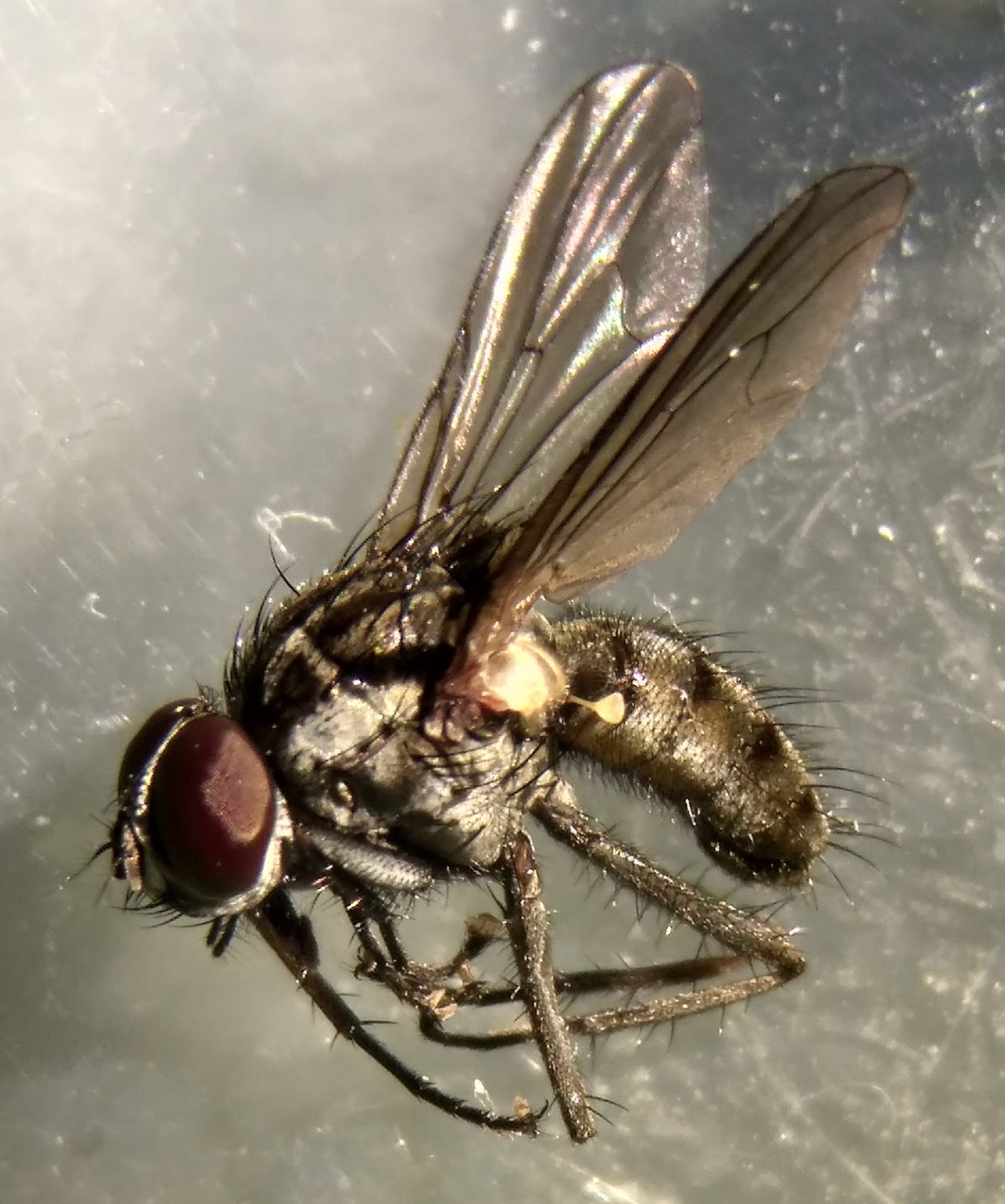
Paradelia intersecta is a super-common anthomyiid (flower fly) in spring, which can be swept from tree branches where large numbers of males can gather. It can be spotted from a sample in the first instance by its short, slightly downcurved abdomen. Unlike some other anthomyiids, the male can be confirmed by the leaf-like structures on the fifth sternite, which are visible without extracting the genitalia (though those are pretty characteristic too).

The nature of sternite 5 in male Anthomyiidae is often a useful character in identification. It's essentially the last "plate" on the underside of the abdomen before the genitalia. Even in the habitus picture below the prominent "leaf" is visible. For an essentially greyish, non-descript fly, this is a real time saver when sorting samples!

Short abdomen, big eyes (small gena)

Prominent leaf-like sternite 5

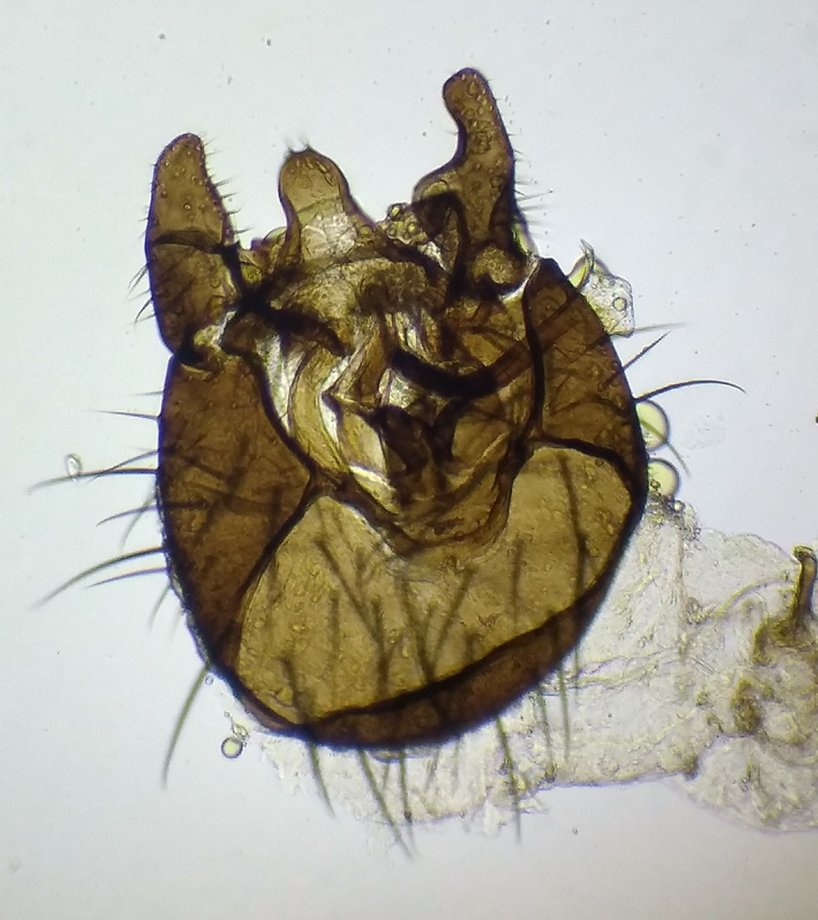
When extracted, the genitalia look like the image below, where you can see how the leaf-like extensions of s5 are attached.


Tuesday, 12 April 2022

Strobilomyia infrequens new to Scotland from Cullaloe Hills, 1st April

The first of the genus in Scotland, this is a fly, and a family, which mines conifer cones. S.infrequens mines Larch in particular, but doesn't appear to be fussy about which Larch. In this case I think it was hybrid, though that needs to be checked. It is noted as a "late" Strobiloyia, in the sense that the female has a long ovipositor, with which she places eggs between cone scales. The "early" species place an egg at the base of a cone. It will be interesting to see if affected cones can be found shortly. Larches are pretty ubiquitous in the UK, so it'll also be interesting if other Larchy places have Strobilomyia species.


Monday, 8 June 2020

Hydrophoria diabata at Braefoot, Dalgety Bay

A male anthomyiid taken yesterday looks very likely to be the above, though NBN only carries one record from Oxford area. This was at some point in the past synonymised with H.lancifer but was subsequently separated again. Presumably this has had an effect on recording and there may be lancifer records which are actually diabata. I have sent pics and await confirmation (edit: confirmed). This is the 2nd confirmed British record, though some may have slipped through under the guise of lancifer.


plumose arista not so common in Anthos

Hook tip

note also the long epandrium

Tuesday, 15 May 2018

Dalgety Bay Hydrophoria ruralis (Anthomyiidae)

Hydrophoria ruralis 
Dalgety Bay, Ross Plantation
NT1683

Initially identified as H.lancifer, which I now think was incorrect.

Abundant on low foliage beside path. Strongly shining fronto-orbital plates, close large eyes and pale thoracic "stripes" catch the eye and make the fly stand out.

Typical posture and position


Dalgety Bay - Ross Plantation, Anthomyia procellaris

An explosion of Anthomyia procellaris males in the woods this lunchtime, with up to 10 on one nettle plant.


Monday, 4 December 2017

Botanophila fugax, Dalgety Bay, 04/xii/2017

Sp.: Botanophila fugax, abundant
Loc: Dalgety Bay, Hopeward Wood
Grid: NT1582
04/xii/2017

On sunny sides of trunks and bench, mostly males but c.5 per surface at any one time.