http://www.spessart-fliegen.de/diptera/sphaeroceridae/sphaeroceridae.html
Showing posts with label #sphaeroceridae. Show all posts
Showing posts with label #sphaeroceridae. Show all posts
Wednesday, 4 March 2020

Opacifrons humida at Dalgety Bay, 03/02/2020
A few small flies were swept around the edge of the bay and the pond margin. Leptocera fontinalis and Lonchoptera lutea were featured along with the ephydrid Parydra quadripunctata.
However, new to me and the second location for Fife was Opacifrons humida (as NBN and the key but in the new British list Pseudocollinella humida). This is a sphaerocerid which is so dusted it's almost olivaceous. It has prominent pre-sutural acros and three pairs of DCs.
 |
| Habitus |
 |
| 3 DCs, pre-sutural acrostichals |
 |
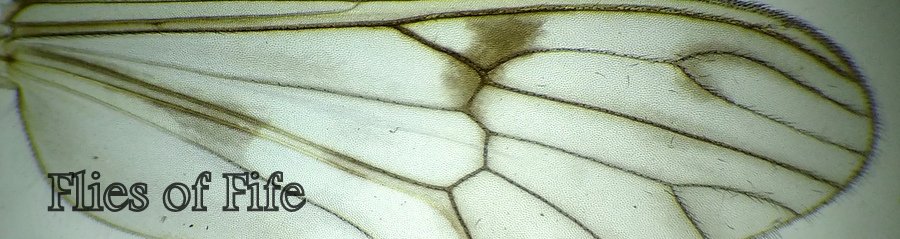
| Wings of O.humida and L.fontinalis |
Monday, 2 March 2020


Thursday, 27 February 2020
Brachypterous lesser dung fly
Found in leaf litter at Dalgety Bay this lovely brachypterous fly is allegedly a common species. Presumably I've just been overlooking it.

You can see the scutellum here with two pairs of marginal spines and no discals. You can see the middle tibia with two anterodorsals in the distal half. You can also see the costa "overshooting" R4+5 (is that the right designation? Sounds a bit off).
Anyway, glad to have it on my Sphaerocerid list. Should be easy enough to recognise in the future too
Thursday, 30 January 2020
Ice cream tub bait trap
One family that's doing very well on the 2020 records is the Sphaeroceridae, or lesser dung flies. So far five species have been identified (and two not!). This is a family I have an emotional tie to (yes, really) because it was one of the first monographs (Pitkin, RES) I acquired when I moved out from hoverflies.
Sphaeroceridae
Copromyza nigrina - fish-baited trap
Crumomyia fimetaria - leaf litter
Crumomyia nitida - fish-baited trap
Crumomyia roserii - fish-baited trap
Lotophila atra - leaf litter
Sieving leaf litter is always a good way to pick up a sphaerocerid or two, but a ground-level bait trap seems like a definite winner. The elevated bottle traps don't seem to catch them - I think because these flies mostly don't get very far away from the ground. This is also a good way to pick up Heleomyzidae, of which 3 species have been found in this session using this trap . One of the species was also found in the elevated bottle trap, but all three were in the low-level trap. The trap is jammed up against a ruined wall so it's probably warmer and more sheltered down there too.
Heleomyzidae
Neoleria propinqua
Scoliocentra villosa
Suillia variegata (in leaf litter, not in trap)
Tephrochlamys rufiventris
Heleomyza captiosa (10.3.20)
The trap design
 |
| Ice cream tub, fish remnants, cardboard disc |
Apart from the flies this trap has yielded about 100 Catops beetles, the only one of which I gen-detted being C.tristis. And boy does it make them crazy - lots of mating pairs. I suspect there may be more than one species of Catops present. Sadly none I've taken have shown signs of fungal infection.
Thursday, 9 January 2020
Crumomyia roserii in Cullaloe Hills
Caught at a fish-baited trap, this little lesser dung fly has yellow-brown tibiae as an "obvious" feature. One previous Fife record from the East Neuk.
Loc: Cullaloe Hills
Grid: NT1888
Date: 08.i.2020
Det.: Crumomyia roserii female
Loc: Cullaloe Hills
Grid: NT1888
Date: 08.i.2020
Det.: Crumomyia roserii female
 |
| infuscated wings |
 |
| yellow tibia |
 |
| pleural dusting pattern is helpful in ID |
Subscribe to:
Posts (Atom)